5 Belly Fat Habits to Change After 40
Hormones, sleep and muscle loss all play a role in belly fat after 40, but daily habits still matter a lot. Here are five realistic changes that help, without crash diets or endless crunches.
By KateLast reviewed

Many women notice it somewhere in their 40s: the same jeans fit differently, and weight seems to settle around the middle even when the scale barely moves. It is frustrating, but it is also very common, and it is not a sign that you are doing everything wrong.
Changing hormones, muscle loss, stress and sleep all play a role. The good news is that daily habits still have a big influence. These five changes target the real drivers of belly fat after 40, without crash diets or 100 crunches a day.
Why belly fat changes after 40
During perimenopause and menopause, estrogen levels drop. Estrogen influences where the body stores fat, and as it falls, more fat tends to be stored around the abdomen instead of the hips and thighs.
At the same time, women naturally lose muscle with age, sleep often becomes lighter, and life in your 40s can be busy and stressful. Together, these changes make the middle more sensitive to old habits that used to work fine.
Visceral fat, the deeper fat around the organs, matters for health, not just looks. It is linked with a higher risk of heart disease and type 2 diabetes. That is why gentle, consistent changes are worth it.
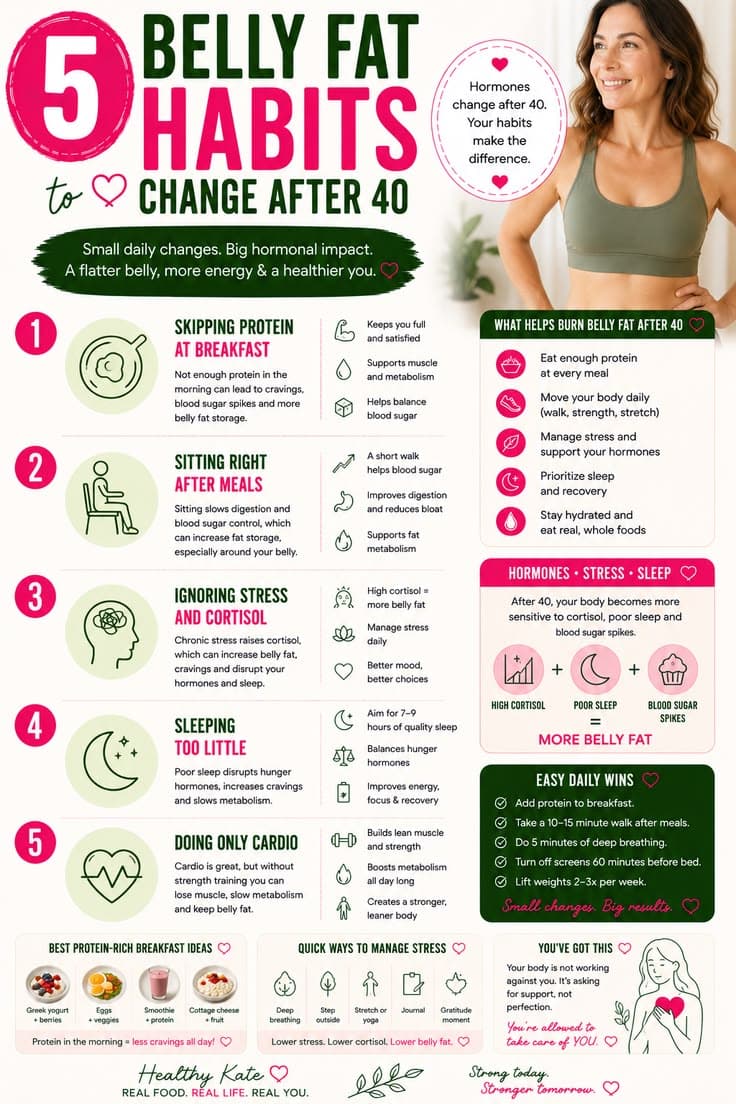
1. Swap "eating less" for "eating more protein"
Many women respond to belly fat by eating less and less, often skipping breakfast and grazing later. This can backfire: too little food and too little protein make it easier to lose muscle and harder to control evening hunger.
Try instead:
- Build every meal around a palm-sized portion of protein: eggs, Greek yogurt, fish, chicken, tofu, lentils.
- Aim for 25 to 30 g of protein at breakfast, for example a high-protein breakfast plate.
- Add fiber-rich vegetables and legumes for volume, like in the Lazy Plate Method.
More ideas are in our guide to protein habits for women over 40.
2. Swap endless cardio and crunches for strength training
Crunches strengthen your core, but they cannot burn the fat on top of it. And long cardio sessions alone do little to protect the muscle you naturally lose after 40.
Try instead:
- Two or three full-body strength sessions per week: squats, lunges, rows, presses, deadlifts.
- Use weights that feel challenging in the last few reps, and increase them slowly.
- Keep daily walking for heart health and stress.
Here is why strength training matters for women's metabolism, with a simple 2-day beginner plan.
3. Swap late nights for a steady sleep routine
Short sleep is linked with more hunger, stronger cravings for sweet and salty food, and more weight gain around the middle. During perimenopause, night sweats and lighter sleep can make this worse.
Try instead:
- Keep the same bedtime and wake-up time, even on weekends.
- Keep the bedroom cool, dark and quiet.
- Stop caffeine after early afternoon.
- Wind down with a calm ritual instead of scrolling.
Our sleep habits for women over 40 go into more detail.
4. Swap the nightly glass of wine for an alcohol-free ritual
Alcohol adds calories that are easy to overlook, it often comes with snacks, and it disrupts deep sleep. Many women notice that cutting back on alcohol makes the biggest difference to belly bloat and evening snacking.
Try instead:
- Keep alcohol for weekends or special occasions.
- Create a new evening drink ritual: sparkling water with lime, peppermint tea or a chilled cucumber lemon water.
- If you drink, have it with a meal and alternate with water.
5. Swap evening snacking for a "kitchen closed" routine
For many women, the hardest time of day is after dinner. Tired, stressed and finally relaxed, it is easy to snack on autopilot.
Try instead:
- Eat a satisfying dinner with protein and vegetables.
- Take a 10-minute walk after dinner; it supports steadier blood sugar and breaks the couch-snack habit.
- Close the kitchen with the 7-minute kitchen closing ritual.
- If you are truly hungry, choose a protein snack like Greek yogurt or a boiled egg.
A simple belly-fat-friendly day
- Morning: water first, 10 minutes of daylight, a protein breakfast.
- Midday: a balanced lunch bowl and a short walk.
- Afternoon: a protein-and-fiber snack if needed, no caffeine after 2 p.m.
- Evening: an earlier dinner, a 10-minute walk, the kitchen closed by 8 p.m.
- Twice a week: 30 minutes of strength training.
Stress plays a role too. If you often feel wired and tired, try these 5 cortisol-balancing habits for weight support and a calm morning routine for energy and focus.
How to track progress (beyond the scale)
When you build muscle and lose fat at the same time, the scale can move slowly. Better signs of progress include:
- Your waist measurement, taken once a month at the level of your belly button
- How your clothes fit
- Strength gains in your workouts
- Energy, sleep quality and fewer cravings
When to talk to your doctor
Sudden weight gain around the middle, very irregular periods, heavy night sweats or extreme fatigue are worth discussing with your doctor. Thyroid problems, medications and other conditions can also affect weight, and menopause symptoms can often be treated.
FAQ
Belly Fat After 40: Questions
Why do women gain belly fat after 40?
Falling estrogen levels during perimenopause and menopause shift where the body tends to store fat, toward the abdomen. Muscle loss with age, poorer sleep, stress and less daily movement often add to the change.
Can you target belly fat with exercise?
No exercise burns fat from one specific area. Crunches strengthen the abdominal muscles but do not remove the fat on top. Overall fat loss through balanced eating, strength training and daily movement reduces belly fat over time.
What is the fastest way to lose belly fat after 40?
There is no safe shortcut. The most reliable combination is a moderate calorie deficit with plenty of protein and fiber, two to three strength sessions per week, daily walking, good sleep and limiting alcohol.
Is belly fat dangerous?
Fat stored deep in the abdomen around the organs, called visceral fat, is linked to a higher risk of heart disease and type 2 diabetes. A waist measurement can be a useful check; ask your doctor what is healthy for you.
Do belly fat supplements work?
No supplement can melt belly fat. Some products may support a healthy routine, but the effect is small compared with habits like protein, strength training, sleep and alcohol reduction. Check with your doctor before trying any supplement.
The bottom line
Belly fat after 40 is not a personal failure. It is a normal change driven by hormones, muscle loss, sleep and stress. You cannot spot-reduce it, but you can change the habits that feed it: more protein, strength training, better sleep, less alcohol and a calmer evening routine. Small swaps, repeated daily, add up.
This article is for general information and does not replace medical advice. Talk to your doctor before making major changes to your diet or exercise routine.