How Many Steps a Day to Lose Weight? What the Research Actually Says
Forget the magic 10,000. Here is what a large study on daily steps found, how many calories your steps really burn and how to raise your count without burning out.
By KateLast reviewed
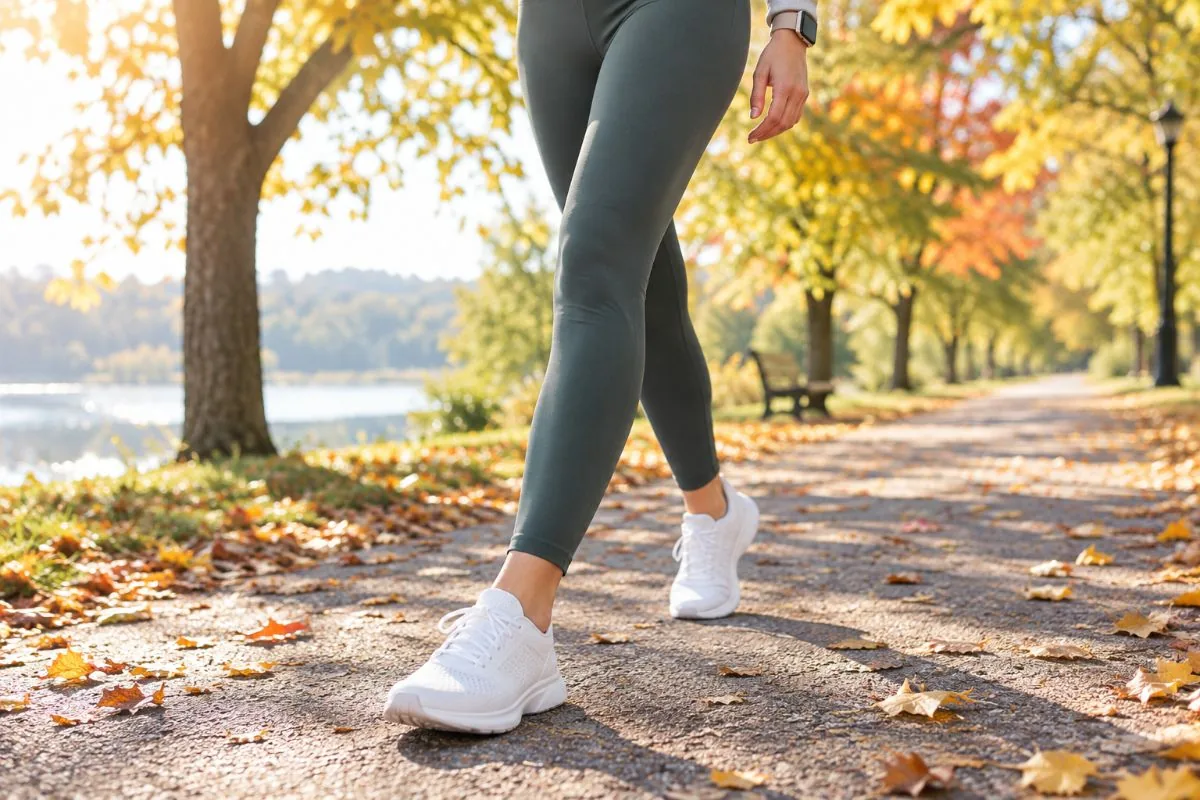
There is no magic number of steps that makes you lose weight. The research-backed answer is this: aim for about 7,000 to 10,000 steps a day for your health, and for weight loss, add a few thousand steps to whatever you do now while you also adjust what you eat.
That may sound less exciting than "walk 10,000 steps and the pounds melt away," but it is far more useful. Below you will find what a large study on step counts found, what your steps really burn in calories and a simple plan to raise your daily number step by step.
What the research says about daily steps
The best data comes from a 2022 meta-analysis in The Lancet Public Health. Researchers pooled 15 studies with 47,471 adults who wore step counters and followed them for a median of about seven years.
They split people into four groups by daily steps. Compared with the lowest group (a median of about 3,550 steps a day), the risk of dying during follow-up was:
- 40% lower at around 5,800 steps a day
- 45% lower at around 7,850 steps a day
- 53% lower at around 10,900 steps a day
The benefit did not keep rising forever. It leveled off at about 6,000 to 8,000 steps a day for adults 60 and older and 8,000 to 10,000 steps for adults under 60. The authors also pointed out that the famous 10,000-step goal has little evidence behind it.
Two honest caveats: these were observational studies, so they show a link, not proof that steps alone caused the difference. And they looked at health and longevity, not weight. Still, they give a realistic target range, and they show that the biggest gains come from moving out of the very low range.
Is there a different number for women?
No. The study included both women and men, and the age-based ranges apply to both. For most women 35 to 59, 8,000 to 10,000 steps is a sensible long-term goal; from 60, 6,000 to 8,000 already captures most of the benefit. If you are at 3,000 steps today, every extra thousand counts.
How many calories do steps burn?
This is where expectations often go wrong. Calories burned depend mostly on your body weight and your pace, so any per-step number is an estimate. Here is the math, step by step.
1. Calories per walk. According to Harvard Health, 30 minutes of walking at 3.5 mph (a 17-minute mile) burns about:
- 107 kcal at 125 pounds
- 133 kcal at 155 pounds
- 159 kcal at 185 pounds
2. Steps per walk. About 100 steps per minute is a practical marker for moderate-intensity walking. A brisk 30-minute walk is therefore at least 3,000 steps, and often a bit more at 3.5 mph.
3. Calories per 1,000 steps. Divide the calories by roughly 3,000 to 3,500 steps and you get about 30 to 50 kcal per 1,000 brisk steps, the lower end for lighter women, the higher end for heavier women.
What that means in practice:
- Adding 2,000 brisk steps a day burns roughly 60 to 100 kcal.
- Over a week, that is about 420 to 700 kcal (60 × 7 to 100 × 7).
- Slow, scattered steps around the house burn less than brisk walking.
These are gross figures that include the calories you would burn anyway at rest, so the true extra burn is somewhat lower. That is why walking alone usually leads to modest weight loss, and why food matters so much. A snack or drink with 150 kcal equals roughly 3,000 to 5,000 brisk steps (150 ÷ 50 × 1,000 to 150 ÷ 30 × 1,000).
Why steps still matter for weight loss
If the calorie numbers are modest, why bother? Because walking does several things that make weight loss easier to sustain:
- It is repeatable. You can walk every day without needing recovery days, and small daily amounts add up over months.
- It counts toward the guidelines. The CDC recommends 150 minutes of moderate activity a week, which is just 30 brisk minutes on five days.
- Timing helps. A short walk after meals is an easy way to collect steps; ten minutes of walking after your evening meal is a good place to start.
- It supports mood and stress. Walking outdoors is a calm break from screens, and there are good reasons why a walk among trees and green space does body and mind good.
For the full picture of how walking fits into weight loss, including posture, intervals and a 4-week starter plan, see our complete guide to walking for weight loss.
A simple step-up plan
Big jumps lead to sore feet and quitting. Small, steady increases stick.
Week 0: Find your baseline. Wear your phone or tracker as usual for one normal week, without trying to change anything. Note your average daily steps.
Weeks 1 to 2: Add 1,000 to 2,000 steps a day. That is about 10 to 20 minutes of walking. Split it up if that is easier: 10 minutes after lunch, 10 after dinner.
Weeks 3 to 4: Add another 1,000 to 2,000. Make at least one walk a day brisk, at a pace where you can talk but not sing.
Week 5 onward: Keep building until you reach your target range (8,000 to 10,000 under 60, 6,000 to 8,000 from 60), then hold it.
Example: If your baseline is 4,000 steps, you would be at about 6,000 after two weeks, 8,000 after four weeks and could settle there or slowly go higher.
Ideas for easy extra steps:
- Take phone calls while walking.
- Park farther away or get off the bus one stop early.
- Book a standing weekly walk with a neighbor; a regular walking buddy makes it much harder to skip.
- Use the stairs for one or two floors.
Steps work best with food habits and strength
Since a day of steps burns a few hundred calories at most, what you eat decides most of the result. Three habits pair especially well with walking:
- Build filling plates. Half vegetables, a palm of protein and some fiber-rich carbs keep portions reasonable without counting; our no-counting plate formula shows how.
- Eat protein at every meal. It keeps you full and helps protect muscle while you lose weight. These simple daily protein habits for women after 40 make it easy. Not sure how much? Here is your daily protein range by weight.
- Add two strength sessions a week. The CDC also recommends at least 2 days of muscle-strengthening activity. Walking does not replace it, and here is how lifting weights helps protect muscle and metabolism.
Who should be careful
- Joint, foot or back pain: increase slowly, choose supportive shoes and softer surfaces and talk to a physical therapist if pain persists.
- Heart disease, diabetes or high blood pressure: ask your doctor which pace and amount are right for you.
- Pregnancy or recovery from surgery: follow your doctor's advice on activity levels.
- Chest pain, dizziness or unusual shortness of breath while walking: stop and seek medical help.
The bottom line
You do not need exactly 10,000 steps. Research suggests health benefits level off at about 8,000 to 10,000 steps a day for adults under 60 and 6,000 to 8,000 from 60. For weight loss, start from your own average, add 1,000 to 2,000 steps a day every week or two, make some of them brisk and pair your walks with protein, filling plates and strength training. Steady steps plus better meals beat any magic number.
This article is for general information and does not replace medical advice. If you have a health condition, joint problems or have been inactive for a long time, talk to your doctor before significantly increasing your activity.
FAQ
Steps and Weight Loss Questions
How many steps a day should a woman take to lose weight?
There is no women-specific number. For health, a large 2022 meta-analysis found the benefits of more steps leveled off at about 8,000 to 10,000 a day for adults under 60 and 6,000 to 8,000 for adults 60 and older. For weight loss, the best target is a few thousand steps above your current average, combined with changes to what you eat.
Is 10,000 steps a day necessary?
No. The researchers behind the large 2022 analysis noted that the popular 10,000-step goal has little evidence behind it. Benefits rose steadily from very low step counts and leveled off below or around that number, depending on age.
How many calories do 10,000 steps burn?
It depends mostly on your body weight and pace. Using Harvard Health's walking figures, a rough estimate is 30 to 50 kcal per 1,000 brisk steps for women weighing about 125 to 185 pounds, so roughly 300 to 500 kcal for 10,000 brisk steps. Slow everyday steps burn less.
Can I lose weight just by walking?
Walking helps, but on its own it usually leads to modest weight loss, because a daily walk burns a few hundred calories at most. It works best together with filling, protein-rich meals and fewer sugary drinks and snacks.
Does it matter how fast I walk?
Yes. About 100 steps per minute is a practical marker for moderate intensity in adults, which is the kind of activity health guidelines recommend. Brisk steps also burn more per minute than slow, scattered steps around the house.
How fast should I increase my steps?
Add about 1,000 to 2,000 steps a day to your current average and keep that level for one to two weeks before adding more. Gradual increases are easier to keep up and kinder to your feet, knees and hips.
Sources
We check health claims against research summaries and official fact sheets. Links open the original source.
- Daily steps and all-cause mortality: a meta-analysis of 15 international cohorts · The Lancet Public Health (PubMed), 2022
- Adult Activity: An Overview · Centers for Disease Control and Prevention, 2026
- Calories burned in 30 minutes for people of three different weights · Harvard Health Publishing, 2026
- How fast is fast enough? Walking cadence (steps/min) as a practical estimate of intensity in adults: a narrative review · British Journal of Sports Medicine, 2018