How Much Protein Do Women Need to Lose Weight? Your Number by Weight (Plus a 100 g Day)
The minimum is 0.8 g of protein per kg of body weight, but weight-loss studies usually use 1.2 to 1.6 g per kg. Here is your range by weight, how to split it across meals and a full day of food that reaches about 100 g.
By KateLast reviewed
If you are a woman trying to lose weight, aim for roughly 1.2 to 1.6 g of protein per kilogram of body weight per day, split into meals of about 25 to 30 g. The official minimum of 0.8 g per kg keeps you out of deficiency, but it is not the amount most weight-loss studies use.
That sounds abstract, so this guide turns it into real numbers: your range by body weight, what a 30 g meal looks like and a full day of ordinary food that adds up to about 100 g.
Why the minimum is not the target
The 0.8 g/kg recommendation is the amount that covers basic needs for most healthy adults. Harvard's Nutrition Source describes it as a minimum, which works out to just over 7 g for every 20 pounds of body weight.
When you eat less to lose weight, protein starts doing extra jobs. A 2015 review in the American Journal of Clinical Nutrition by Leidy and colleagues looked at the research on protein and weight loss and found that higher-protein diets of about 1.2 to 1.6 g per kg per day were linked to:
- more fat loss and better preservation of lean muscle in tightly controlled studies
- greater fullness after higher-protein meals
- improvements in some heart health markers, such as triglycerides and waist size
There is an honest catch. In longer studies the results were mixed, and the authors concluded that the main difference was whether people actually stuck to the plan. So the best protein target is one you can eat comfortably every day, not the highest number you can find.
Protein also works best alongside resistance exercise. If you are not lifting yet, here is why strength training helps protect muscle while you lose weight.
Your daily protein number by body weight
To find your range, multiply your weight in kilograms by 1.2 and by 1.6. In pounds, multiply by about 0.55 and 0.73 instead. Here are worked examples, with the 0.8 g/kg minimum for comparison:
60 kg (132 lb)
- Minimum: 60 × 0.8 = 48 g
- Weight-loss range: 60 × 1.2 = 72 g to 60 × 1.6 = 96 g
- Per meal (3 meals): about 24 to 32 g
70 kg (154 lb)
- Minimum: 70 × 0.8 = 56 g
- Weight-loss range: 84 to 112 g
- Per meal (3 meals): about 28 to 37 g
80 kg (176 lb)
- Minimum: 80 × 0.8 = 64 g
- Weight-loss range: 96 to 128 g
- Per meal (3 meals): about 32 to 43 g, or three meals of 30 g plus a snack
90 kg (198 lb)
- Minimum: 90 × 0.8 = 72 g
- Weight-loss range: 108 to 144 g
- Per meal: three meals of about 30 to 35 g plus one or two protein snacks
If you have a lot of weight to lose, the upper end can feel like a huge amount of food. Starting at the lower end of your range is perfectly reasonable, and a registered dietitian can tell you whether to base your number on your current or a goal weight.
How much protein per meal?
The same review suggests aiming for at least 25 to 30 g of protein per meal. That spacing matters more than it seems. Many women eat a light breakfast with maybe 10 g of protein and save most of their protein for dinner, which leaves the morning and afternoon running on little.
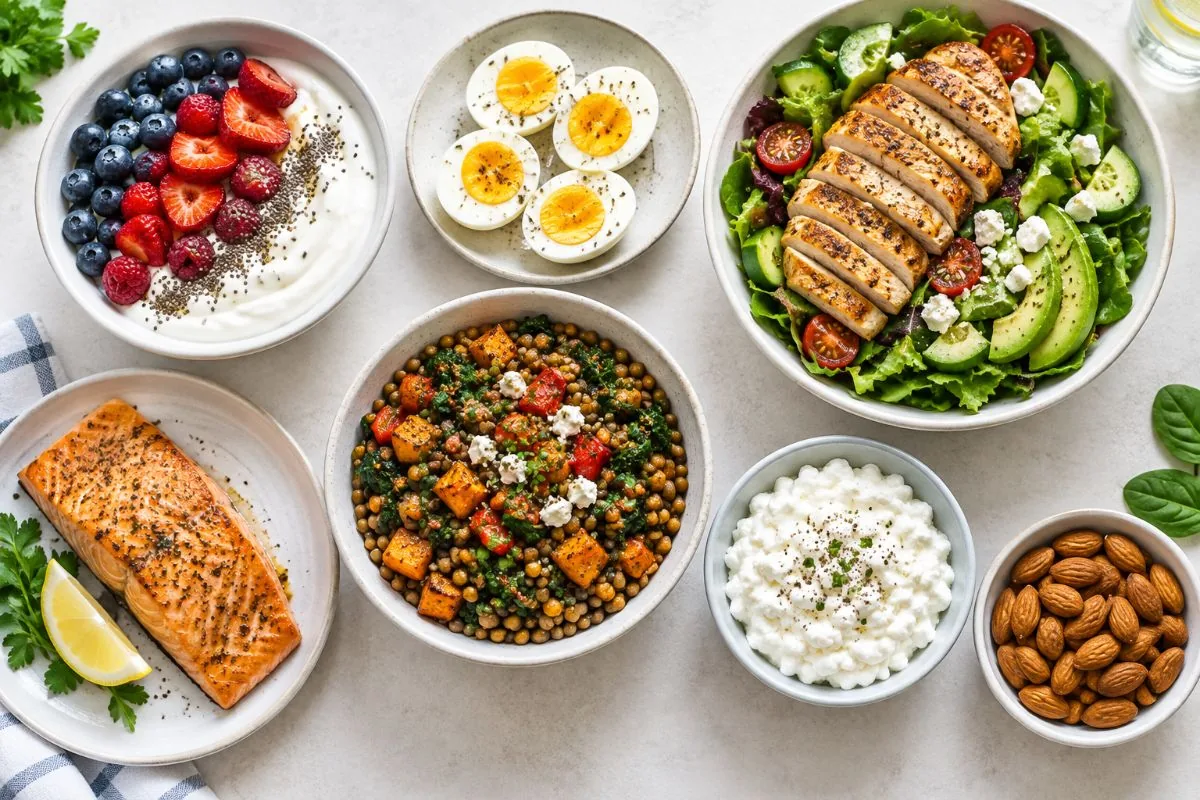
A simple rule: build every meal around one main protein food, then add a second, smaller one. Some examples using USDA values:
- 2 large eggs: about 12.6 g (one 50 g egg has about 6.3 g)
- 3/4 cup (170 g) plain nonfat Greek yogurt: about 16 g
- 1/2 cup (113 g) 2% cottage cheese: about 12 g
- 3 oz (85 g) cooked chicken breast: about 26 g
- 4 oz (113 g) cooked salmon: about 25 g
- 1/2 cup (99 g) cooked lentils: about 9 g
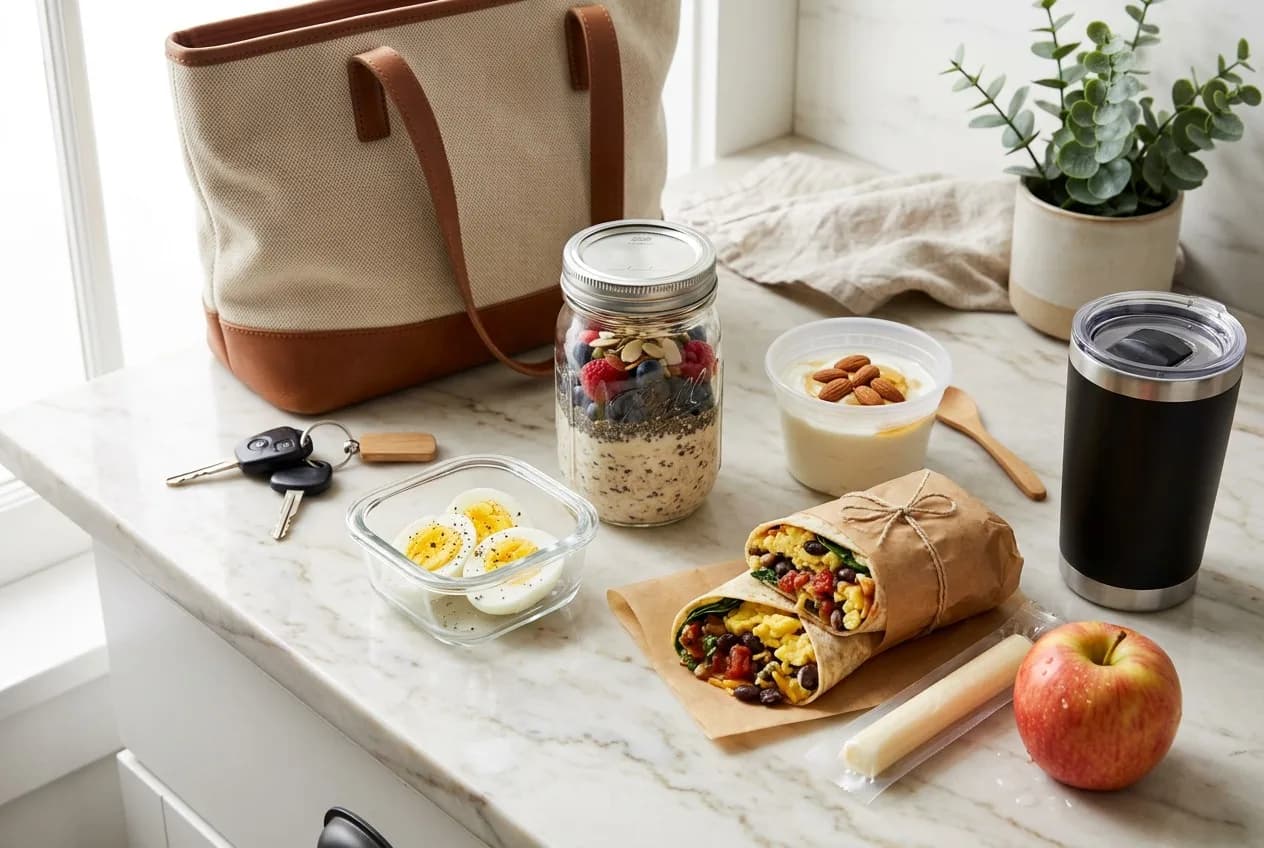
Breakfast is usually the hardest meal to fix. These ten breakfasts that land near 30 g of protein, with the math shown make it easy, and if you eat in the car or at your desk, try these portable high-protein breakfasts for rushed mornings.
A sample day with about 100 g of protein
This plan fits a woman of around 65 to 80 kg aiming for the middle of her range. Numbers are calculated from USDA FoodData Central values:
Breakfast: about 28 g
- 2 large eggs, scrambled: 12.6 g
- 1/2 cup (113 g) 2% cottage cheese with tomatoes or fruit: 11.8 g
- coffee with 1/2 cup (122 g) 2% milk: 4.0 g
Lunch: about 35 g
- 3 oz (85 g) cooked chicken breast over a big salad: 26.4 g
- 1/2 cup (99 g) cooked lentils on top: 8.9 g
Afternoon snack: about 16 g
- 3/4 cup (170 g) plain nonfat Greek yogurt with berries and cinnamon: 16.2 g
Dinner: about 25 g
- 4 oz (113 g) baked salmon with roasted vegetables and potatoes: 25.0 g
Total: 28.4 + 35.3 + 16.2 + 25.0 = about 105 g, before counting the few extra grams in bread, grains and vegetables.
Notice that each meal also has vegetables, fruit or legumes. Fiber and protein together tend to keep you satisfied longer, and this guide to pairing protein with fiber for longer-lasting fullness has more combinations.
Easy ways to raise your protein without counting every gram
You do not need an app to make this work. A few habits do most of it:
- Fill a quarter of your plate with protein. If you prefer not to track at all, a no-counting plate method gets you close to 25 to 30 g per meal automatically.
- Upgrade your breakfast first. Moving from 10 g to 25 g at breakfast often makes the biggest difference. There are plenty of breakfasts that keep you full until lunch to rotate through.
- Cook protein in batches. A tray of chicken, a pot of lentils and a dozen boiled eggs on Sunday cover several lunches.
- Use dairy as a booster. Greek yogurt in dressings, cottage cheese with fruit or milk in your coffee each add a few easy grams.
- Mind your age. Needs and appetite change in midlife, so here are some protein habits that work well after 40.
Who should be careful
Higher-protein eating is considered safe for most healthy adults, but it is not right for everyone. Talk to your doctor or a registered dietitian before increasing your protein if you:
- have chronic kidney disease or reduced kidney function
- have liver disease
- have been told to follow a protein-restricted diet
- are pregnant or breastfeeding and unsure how much you need
Harvard's Nutrition Source notes that people with certain conditions, including kidney and liver disease, need to set their protein intake with their physician.
The bottom line
For weight loss, most women do well somewhere between 1.2 and 1.6 g of protein per kilogram of body weight, which is roughly 72 to 96 g at 60 kg and 108 to 144 g at 90 kg. Spread it over three meals of about 25 to 30 g, add a protein snack if you need it and pick foods you enjoy, because consistency is what makes the difference over months.
This article is for general information and does not replace medical advice. If you have kidney or liver disease, another chronic condition or take medication, talk to your doctor or a registered dietitian before changing your protein intake.
FAQ
Protein for Weight Loss: Your Questions
How much protein should a woman eat a day to lose weight?
The general minimum for adults is 0.8 g per kilogram of body weight. Many weight-loss studies use about 1.2 to 1.6 g per kilogram. For a 70 kg (154 lb) woman, that is roughly 84 to 112 g of protein a day.
How much protein should I eat per meal to lose weight?
About 25 to 30 g per meal is a practical target that research reviews suggest. Three meals in that range give you 75 to 90 g, and a protein-rich snack can close the gap to your daily number.
How do I calculate my protein needs in pounds?
Multiply your weight in pounds by about 0.55 for the lower end (1.2 g/kg) and by about 0.73 for the upper end (1.6 g/kg). A 150 lb woman lands at roughly 82 to 110 g a day.
Is 100 g of protein a day too much for a woman?
For most healthy women who are trying to lose weight, 100 g falls inside the range used in research, especially at 65 kg (143 lb) or more. If you have kidney disease or another medical condition, ask your doctor what amount is right for you.
Do I need protein powder to reach my goal?
No. Eggs, Greek yogurt, cottage cheese, chicken, fish and lentils can get you to about 100 g in a normal day, as the sample plan in this article shows. Powder is simply a convenient option.
Sources
We check health claims against research summaries and official fact sheets. Links open the original source.
- The role of protein in weight loss and maintenance (Leidy et al.) · American Journal of Clinical Nutrition, 2015
- Protein · Harvard T.H. Chan School of Public Health, The Nutrition Source, 2026
- Chicken, broilers or fryers, breast, meat only, cooked, roasted (FDC ID 171477) · U.S. Department of Agriculture, FoodData Central, 2026
- Yogurt, Greek, plain, nonfat (FDC ID 171312) · U.S. Department of Agriculture, FoodData Central, 2026
- Fish, salmon, Atlantic, farmed, cooked, dry heat (FDC ID 175168) · U.S. Department of Agriculture, FoodData Central, 2026
- Egg, whole, raw, fresh (FDC ID 171287) · U.S. Department of Agriculture, FoodData Central, 2026