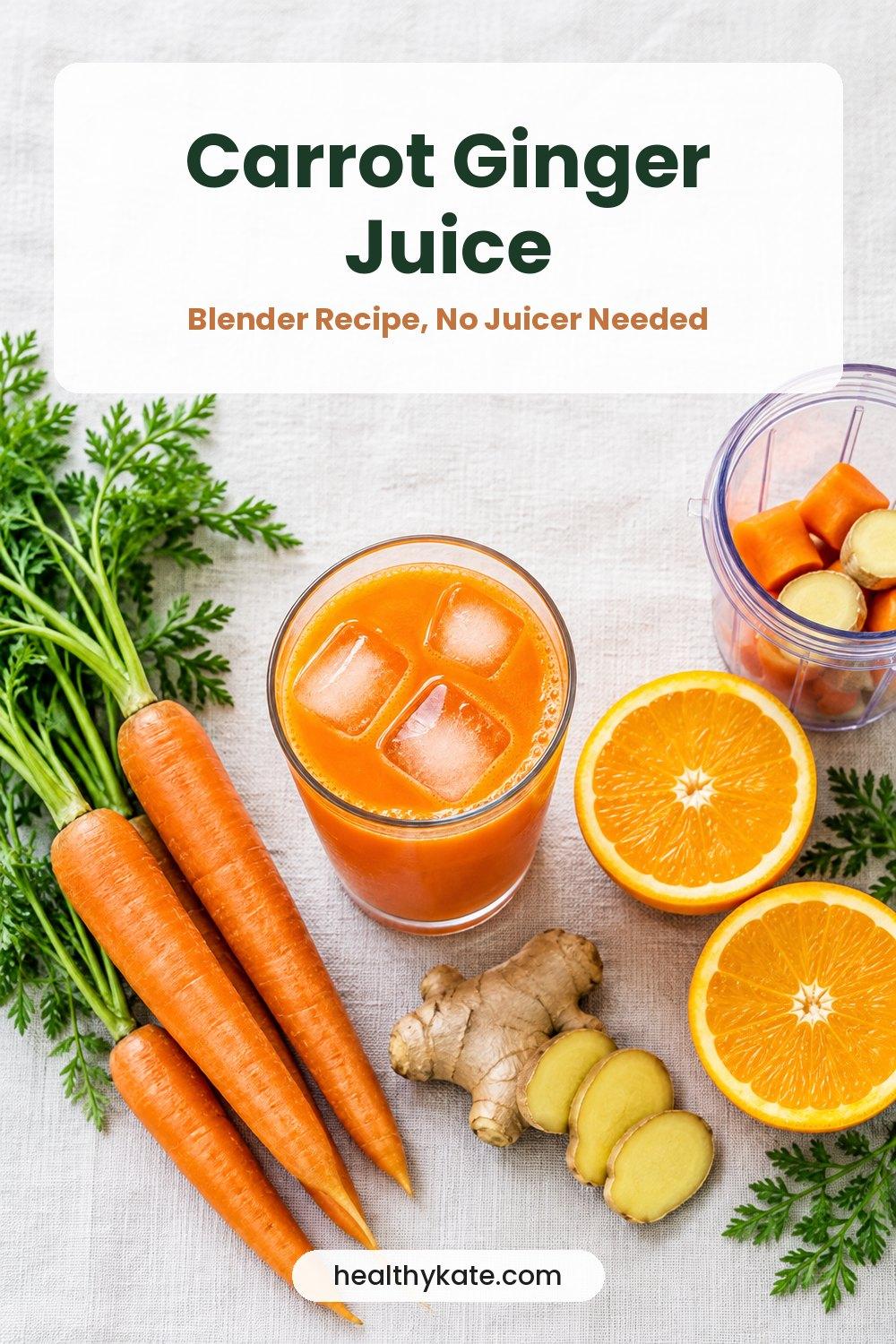
Carrot Ginger Juice in a Blender (No Juicer Needed)
Four carrots, an orange, a knob of ginger and a regular blender. This carrot ginger juice takes 10 minutes, keeps its fiber if you skip the strainer and gives you about 150% of your daily vitamin A in one glass.
By KateLast reviewed
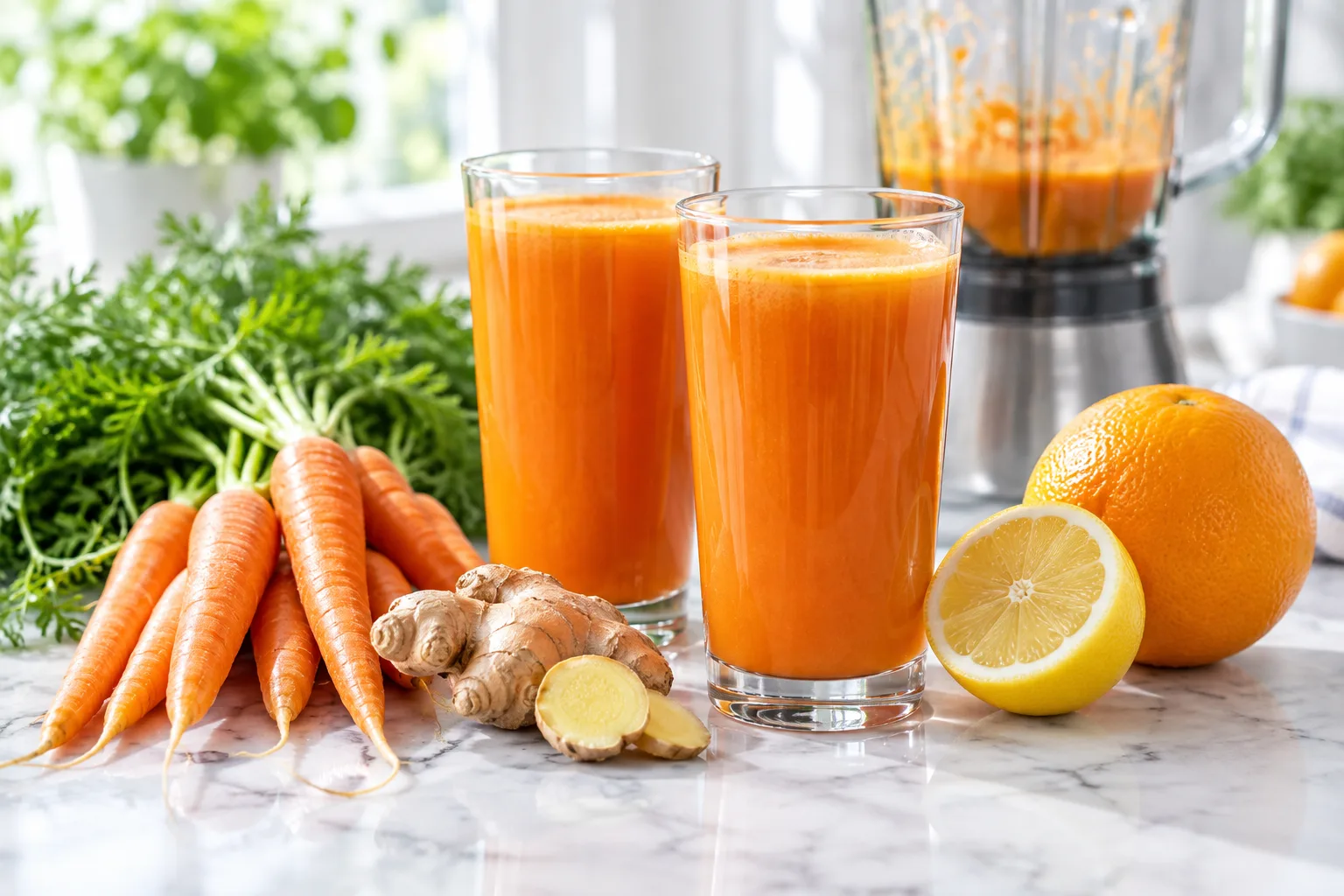
You can make carrot ginger juice without a juicer: blend 4 carrots, 1 peeled orange, a 1-inch piece of ginger, 2 tablespoons of lemon juice and 1 cup of water until smooth, then drink it as is or strain it. It makes two glasses in about 10 minutes.
Leave the pulp in and each glass has about 90 kcal and 5 g of fiber. Strain it and you get a lighter, more classic juice, but most of that fiber stays in the bag.
Recipe
Blender Carrot Ginger Juice With Orange
- Prep:
- 10 min
- Total:
- 10 min
- Serves:
- 2 glasses (about 11 oz / 330 ml each)
Ingredients
- 4 medium carrots (about 250 g), scrubbed and cut into chunks
- 1 medium orange (about 130 g), peeled
- 1-inch piece fresh ginger (about 10 g), peeled
- 2 tbsp fresh lemon juice (about 1/2 to 1 lemon)
- 1 cup (240 ml) cold water
- A handful of ice cubes, optional
Instructions
- 1Put the water, orange and lemon juice in the blender first, then add the carrots and ginger on top.
- 2Blend on high for 60 to 90 seconds, until completely smooth. Add a splash more water if the blender struggles.
- 3For a smoothie-style juice, pour it straight over ice. For a thinner, clearer juice, strain it through a nut-milk bag or fine sieve and press out the liquid.
- 4Taste and adjust with more lemon or ginger. Drink right away or chill for up to 24 hours and stir before serving.
Approx. about 90 kcal per glass, unstrained. Nutrition values are estimates.
What's in one glass
Here is the math for one of two glasses, made unstrained, using USDA values for raw carrots, orange, ginger and lemon juice:
- Calories: about 90 kcal
- Natural sugar: about 12 g, mostly from the carrots and orange
- Fiber: about 5 g (most of it is lost if you strain)
- Vitamin A: about 1,050 µg RAE, roughly 150% of the 700 µg women need per day
- Potassium: about 550 mg
- Vitamin C: about 48 mg
For comparison, a cup of canned carrot juice has about 94 kcal, 9 g sugar and only about 2 g fiber. The blender version gives you more of the carrot.
Blender vs. juicer: strain it or keep the pulp?
A juicer separates the liquid from the fiber. A blender keeps everything, so you choose:
- Unstrained (smoothie-style): thicker, more filling, keeps the fiber. This is the version to pick if you want it to hold you over until lunch. If you are working on getting more fiber in general, our simple fiber habits for women over 40 show where else it can come from.
- Strained: pour the blend into a nut-milk bag or a fine sieve lined with a thin kitchen towel and squeeze. Save the pulp for muffins, soups or veggie patties.
Two blender tips that make a big difference: put the liquid in first so the blades catch, and cut the carrots into coin-sized pieces if your blender is not a high-speed one.
Three variations
Carrot, apple and ginger
Swap the orange for 1 cored apple. It is a little sweeter and less tangy. Add an extra squeeze of lemon to keep it bright.
Carrot, orange and turmeric
Add 1/2 teaspoon ground turmeric and a pinch of black pepper. It turns deep orange and tastes earthier. If you like that flavor, our turmeric water for mornings or evenings uses the same pairing in a lighter drink.
Green carrot juice
Add a big handful of spinach. The color turns brownish-green, but the taste barely changes. For a properly green blend, try our blender green juice with cucumber and spinach instead.
How much ginger?
A 1-inch piece (about 10 g) for two glasses gives a gentle warmth. Go up to 1.5 inches if you like a clear kick. If you want something much stronger, make a fiery ginger turmeric wellness shot and keep the juice mild.
Ginger can cause heartburn or an upset stomach in some people, according to the NIH's complementary health center, so start small if you are sensitive. And if you simply like the taste of ginger without the carrots, warm or iced ginger water is the zero-calorie option.
How much should you drink?
One glass a day is a good limit. Harvard's Nutrition Source recommends keeping juice to about one small glass daily, because liquid calories are easy to drink and less filling than whole food. With carrot juice there is a second reason: one glass already covers your vitamin A for the day.
That vitamin A comes as beta-carotene, which your body converts as needed. According to the NIH Office of Dietary Supplements, beta-carotene from food has no upper limit and is not known to cause vitamin A toxicity. Very large amounts over weeks can turn your skin slightly yellow-orange (carotenodermia), which is harmless and fades once you cut back. High-dose beta-carotene supplements are a different story, especially for smokers, so do not confuse the two.
Does carrot juice help with weight loss?
Not on its own. No juice burns fat. Where it can help is as a swap: a glass of this has about 90 kcal, which is less than a typical glass of orange juice or a can of regular soda, and the unstrained version comes with fiber.
The smartest way to use it is next to a meal, not instead of one. A glass with eggs, Greek yogurt or cottage cheese gives you protein and fiber together, which keeps you full far longer than juice alone.
Storage
Fresh is best, but it keeps:
- Fridge: up to 24 hours in a sealed jar. It separates, so shake before drinking.
- Freezer: pour into ice-cube trays and add 3 or 4 cubes to a smoothie, like our frozen pineapple and chia smoothie.
More homemade drinks
If you like making your own drinks, browse ten easy drinks that make staying hydrated less boring, or try a handful of drinks built around ginger, turmeric and berries for colder days.
This article is for general information and does not replace medical advice. Talk to your doctor before making changes, especially if you have a health condition, are pregnant or take medication.
FAQ
Carrot Ginger Juice Questions
Can you make carrot juice in a blender without a juicer?
Yes. Blend chopped carrots with a little water until completely smooth, then either drink it as is or strain it through a nut-milk bag or fine sieve. A powerful blender gives the smoothest result, but a regular one works if you cut the carrots small and blend a little longer.
Should I peel carrots for juice?
You don't have to. Scrubbing them well under running water is enough. Peel them if the skins are very dirty, bitter or not organic and you prefer a cleaner taste.
How much carrot juice should I drink a day?
One small glass a day is plenty. Harvard's Nutrition Source recommends limiting juice to about one small glass daily, and one glass of this recipe already covers about 150% of the vitamin A a woman needs per day.
Can carrot juice turn your skin orange?
Yes, if you drink a lot of it for weeks. Large amounts of beta-carotene can cause carotenodermia, a harmless yellow-orange tint to the skin that fades when you cut back. Beta-carotene from food is not known to cause vitamin A toxicity.
Is carrot ginger juice good for weight loss?
It can fit into a weight-loss plan, but it does not burn fat. A glass has about 90 kcal, and keeping the pulp keeps about 5 g of fiber, which makes it more filling than strained juice. Drink it with a protein-rich breakfast rather than as a meal on its own.
How long does homemade carrot juice last?
Up to 24 hours in a sealed jar in the fridge. It separates as it stands, so shake or stir it before drinking. For longer storage, freeze it in ice-cube trays and blend the cubes into smoothies.
Sources
We check health claims against research summaries and official fact sheets. Links open the original source.
- Carrots, raw (SR Legacy, FDC ID 170393) · USDA FoodData Central, 2019
- Carrot juice, canned (SR Legacy, FDC ID 170491) · USDA FoodData Central, 2019
- Vitamin A and Carotenoids – Fact Sheet for Health Professionals · NIH Office of Dietary Supplements, 2025
- Healthy Drinks · Harvard T.H. Chan School of Public Health, The Nutrition Source, 2024
- Ginger: Usefulness and Safety · National Center for Complementary and Integrative Health (NIH), 2025